Roemheld introduced new magnetic clamping systems at MACH 2026

5 Mins
Published in Events
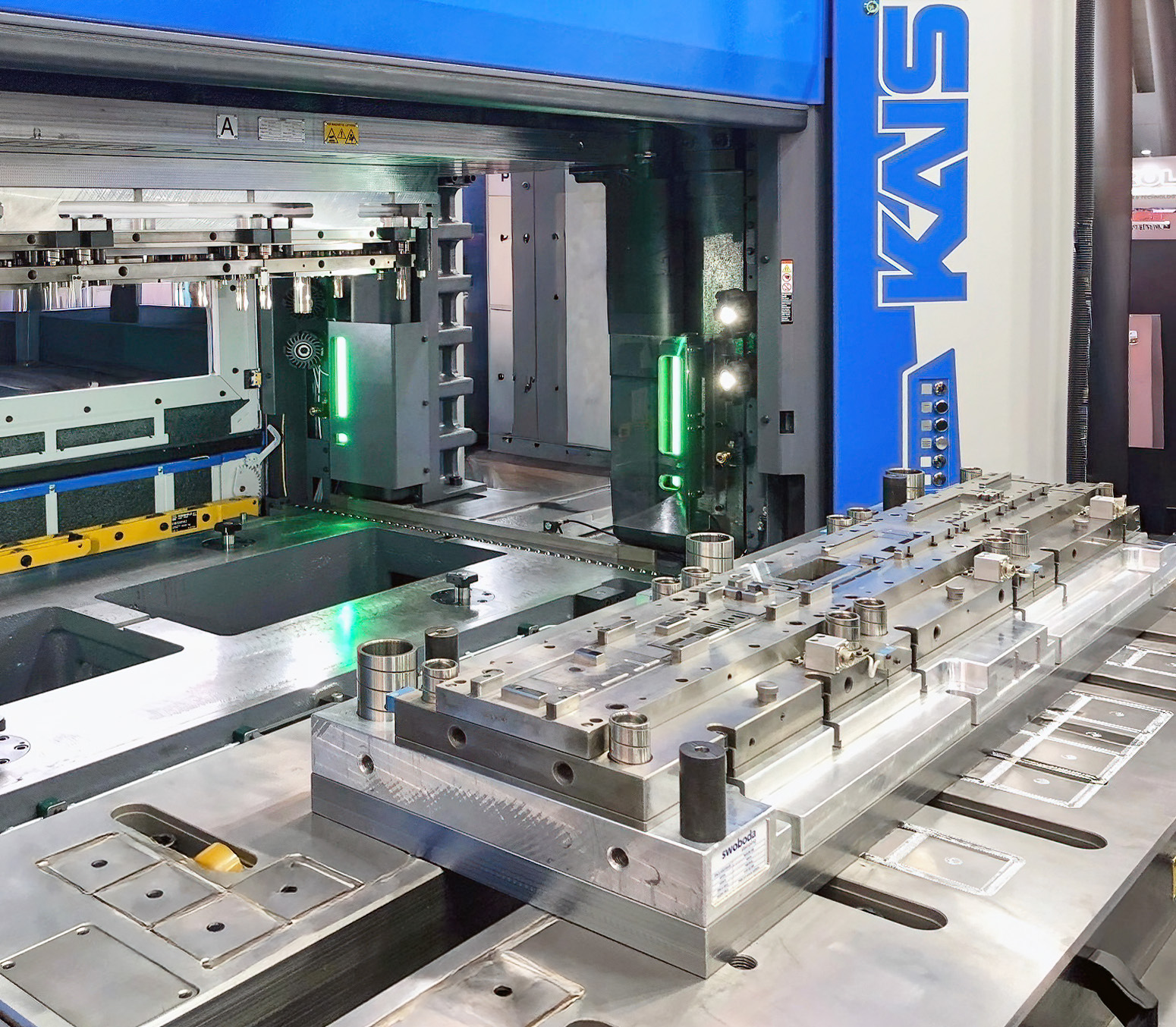
At the recent MACH 2026 exhibition in Birmingham, Roemheld showed for the first time in the UK two advanced magnetic clamping products, R-MAG-M and R-MAG-P. These new magnetic clamps are designed to raise production efficiency in sheet metal forming and plastic injection moulding respectively. Both systems feature innovative, long pole technology, which provides high clamping forces.
The customisable electro-permanent magnetic systems allow die or mould changes in just a few minutes, with clamping or unclamping achieved in one second at the touch of a button. By utilising permanent magnets to generate retention force, the plates remain de-energised and safely in position during operation, ensuring that tools stay firmly clamped even in the event of a power failure.
Safety and monitoring are central to the new designs, which incorporate sensors to monitor the entire clamping cycle. This includes inductive position monitoring of die contact, flux sensors to detect even the smallest movement and permanent temperature monitoring. All operations are managed via a colour touchscreen that provides clear, colour-coded status data. Digital integration via protocols such as VNC and VPN allows remote diagnostics and troubleshooting.
Handling innovations
Elmo RW 850
Roemheld also launched the Elmo RW 850, a compact addition to the company’s line of mould and die-changing carts, designed for environments where space is at a premium. Unlike larger models in the range, the 850 variant is especially manoeuvrable. With its tight turning radius, it’s able to negotiate narrow aisles and cramped production floors that often make changing injection moulds and punching dies arduous or logistically difficult.
Movement of the cart is electrically powered under manual control. What sets the Elmo apart is its integration of ergonomic safety measures and precision control. It features an electro-hydraulically actuated scissor lift with precise height adjustment and a table equipped with hydraulic ball bars, allowing near-frictionless positioning of tools weighing up to 850 kg. For security, the table has protection rails around the periphery and the ball inserts automatically lower during transport, ensuring the tool sits firmly on the table.
While Roemheld’s RW range is for entry-level mould and die changing, where the operator manually slides the tool on to the machine bed, its QDC (quick die change) range features integrated push-pull chain drives for medium to heavy tools. At the touch of a button, these systems grasp the tool and pull it into position, and push it out again after use, removing the need for physical effort from the operator.
An example from this range was on the stand in the form of a station that can be loaded ergonomically with a tool from the front or from either side. All QDC systems enable manufacturers to handle smaller batch production more economically, while reducing strain and injury risks.
ModuHub
Featured was Roemheld’s ModuHub equipment. Its primary function is to provide a standardised platform for manual assembly where workpieces can be positioned, clamped and moved with high precision. Using a plug-and-play approach, the system allows manufacturers to quickly swap out different modules, such as rotating units, tilting stations and height adjusters, to suit the specific ergonomic and technical needs of a project.
ModuHub is engineered for Industry 4.0 integration. It often features integrated ducting for power, compressed air and data, ensuring that the workspace remains free from external cabling. Connectivity allows the equipment to communicate with control units, facilitating real-time monitoring of clamping pressures and positioning data. For businesses looking to scale, it offers a future-proof solution that balances human-centric ergonomic design with the efficiency of a highly connected, automated environment.
Workholding for machining
B 1.8270
A new, compact, hydraulically-actuated clamp suitable for securing workpieces and fixtures in confined spaces, repeatably and with high force, was a further product launch. The B 1.8270 workholding system is particularly well suited to clamping castings, dies, moulds and fixtures prior to metal cutting, especially those that need to be held on narrow grooves, recesses or pockets.
The design of the kinematics that allows such high holding force in a constricted area are sufficiently innovative to have been granted a patent. Rather than swinging or rotating into position, the clamping lever first moves horizontally to the point on the workpiece where it’s to be held and then moves vertically downwards to complete the operation. This movement sequence allows space-saving, precise workpiece clamping for machining. The high holding force means that fewer clamps are needed to secure a part, saving both set-up time and expense.
The product is supplied in a low-profile, plug-in design that does not need external pipework. Users can select from several configurations, including models with a standard short lever, a lever blank for custom adaptation, or without a lever to suit specific workpiece geometries. A quick-change mechanism allows easy lever exchange, providing flexibility for different workholding tasks.
With a clamping force of 6.5 kN at the maximum operating pressure of 220 bar and a horizontal stroke of 8 mm, the hydraulically double-acting clamping element offers high performance, despite its small footprint. The workholding action can be effected at any point along the subsequent vertical stroke of the lever, which is up to 4 mm. This enables the machining of a batch of workpieces that may have slight dimensional differences.
Constructed from hardened stainless steel and with nitrile butadiene rubber and polyurethane seals, the device is built to withstand rigorous industrial conditions up to 80°C. To ensure process reliability in automated production environments, the unit is available with optional pneumatic position monitoring to confirm either clamped or unclamped status. A third variant may be supplied without position control.
Hilma.UC 125
Making another appearance was the Hilma.UC 125, a mechanically-operated, self-centring machine vice designed for high-precision 3- to 5-axis milling. The modular workholding station features a design that allows easy tool access from all sides, enabling the use of short cutters for increased accuracy.
The system utilises two individual jaws that travel simultaneously toward the centre to clamp workpieces with a force of up to 52 kN. Precision is maintained through a central bearing that ensures every component is located within ± 0.01 mm repeatability, while an active pull-down mechanism prevents the workpiece from lifting once secured.
The universal clamp (UC) is capable of accommodating a variety of prismatic and round geometries. Its modular concept includes numerous jaw options up to 125 mm wide and an opening that can be extended to 600 mm, which is among the largest available on the market.
To prevent base distortion, the vice employs separate tensioning and adjustment spindles so that clamping forces are not applied directly to the base. For mounting flexibility, the Hilma.UC 125 can be secured directly to a machining table or integrated into a zero-point clamping system using optional adapter plates.
Swing clamps
Demonstrating the German manufacturer’s diverse range of products for securing parts for machining, Roemheld also had on its stand at MACH a variety of powered swing clamps, which are either hydraulically or electrically actuated. They function by rotating a clamping arm over a workpiece and then pulling down to secure it and are primarily designed for use in automated production environments. The arm swivels completely out of the way when retracted, leaving the work area unobstructed for loading and unloading.
Electric swing clamps are an ideal eco-friendly solution for environments. Driven by a maintenance-free 24V DC motor, the units often utilise IO-Link connectivity to provide real-time data feedback on clamping force and position. They are inherently safe due to a self-locking spindle drive that maintains holding pressure even during a power failure and they include built-in sensors that immediately halt movement if the arm encounters an obstruction.
Hydraulic swing clamps are the industrial standard for applications requiring maximum holding power. Capable of generating forces exceeding 40 kN, the units are available in single-acting versions that retract via spring force or double-acting versions that use hydraulic pressure for faster, more predictable cycle times in automated lines. They are built for extreme durability, often rated for a million cycles, and offer various mounting styles including threaded-body versions that can be integrated directly into fixtures to save space.
Stark zero-point clamping
Additionally, there was a range of Stark zero-point clamping solutions on the stand. Available in manual, hydraulic and pneumatic versions, they are capable of repeatability as high as ±3 microns. As with all zero-point systems, the primary goal is to move fixturing time offline. While one part is being machined, the operator can prepare the next job on a separate pallet. Changeover takes only seconds, reducing setup times by up to 90%, increasing spindle uptime and making it profitable to run small batches or even single-piece orders.
Want to know more about this article?
Ask us below...