Compact rotary tables offer large five-axis machining volumes

2 Mins
Published in Workholding
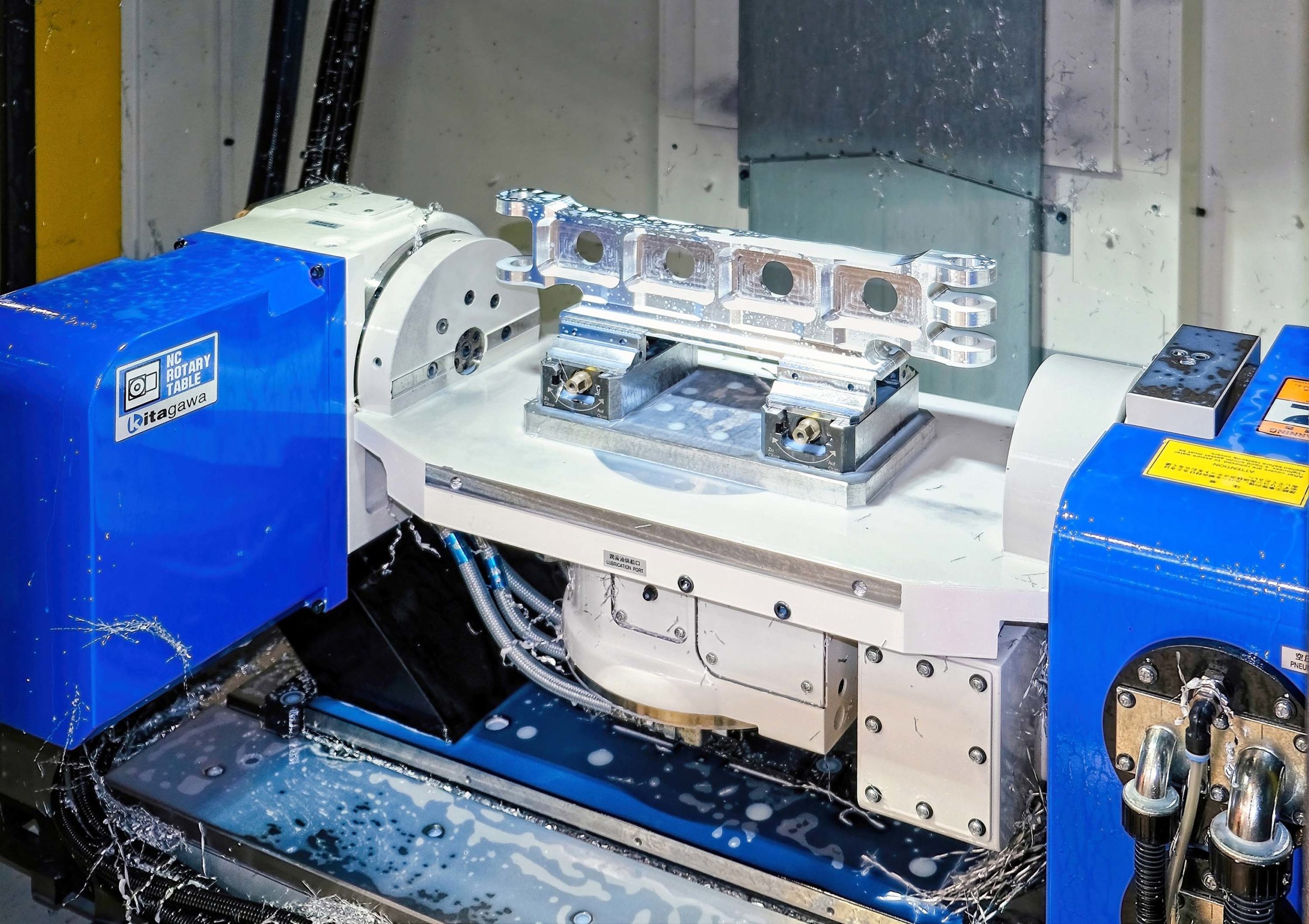
Designed to convert small, three-axis, vertical-spindle machining centres (VMCs) into five-axis production centres, while at the same time allowing them to punch above their weight in terms of workpiece size, Kitagawa has launched two new compound rotary tables. The Japanese-manufactured RKT500 and RKT600 are available in the UK and Ireland exclusively through sales agent 1st Machine Tool Accessories.
The intended host machine is one of the many 30-taper VMCs on the market that only has linear CNC motions, to which the tables add two rotary axes. Smaller 40-taper machines may be similarly converted, or even 50-taper models, provided that the maximum thrust forces during cutting are adhered to.
RKT500 tables can accept workpieces up to 500 mm in diameter by 270 mm high, the respective dimensions for the RKT600 being 600 and 320 mm. The maximum weight of workpiece and fixture is 100 kg in both cases.
From detailed discussions with its user base during the design phase of the tables, Kitagawa recognised the importance of making a large quantity of services available to the faceplate to support the automation of workholding. Both tables are provided with a coolant port and the RKT500 rotary table has six hydraulic or pneumatic ports, with the RKT600 offering 10.
Utilising its patented, multi-plate braking technology, on both rotary tables Kitagawa is able to deliver 740 Nm of clamping torque for the tilting axis and 600 Nm for the rotating axis. Speed throughout the -30/+120 degree tilt angle is 80 rpm, table rotation being 70 rpm and 50 rpm for the smaller and larger models respectively.
A defining feature of the tables is their high accuracy positioning, to within 30 arc-seconds in both the rotary and tilt axes, with ± 2 arc-seconds repeatability. This precision is largely thanks to Kitagawa’s roller gear cam mechanism which, compared with a traditional worm gear drive, offers the advantages of zero-backlash, high torque transmission efficiency, high rigidity and fast indexing speed. The latter is important to avoid delaying cutter access to the workpiece after a high-speed tool exchange.
Once each axis has arrived at its allotted angular position, it’s clamped using Kitagawa’s multi-disc braking technology. This key feature allows the rotary tables to achieve higher clamping torques than competitor systems, reports 1st MTA, without increasing the physical size of the unit. By stacking discs together, the total frictional surface area presented for braking is maximised, while minimising the table’s footprint.
Want to know more about this article?
Ask us below...