JCB Hydromax: The power behind new land speed record

4 Mins
Published in News
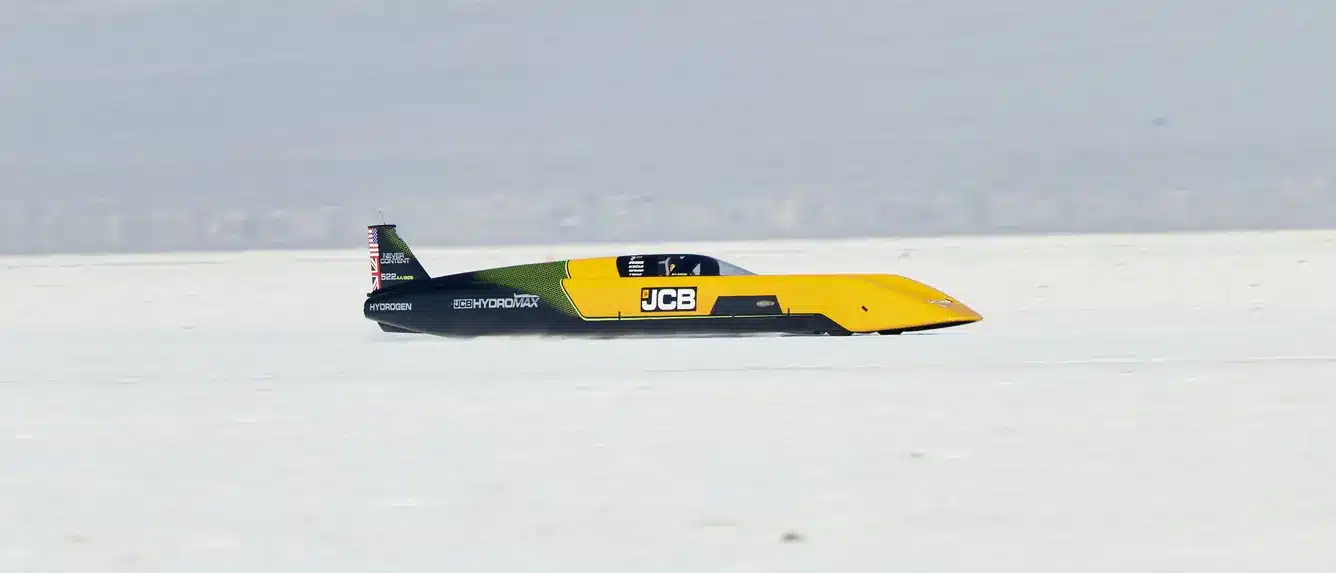
Some 20 years on from the JCB Dieselmax breaking the world diesel land speed record at 350.092 mph, JCB Hydromax has set a new world land speed record of 406.320 mph.
On 11 August, the team returned to Bonneville Salt Flats in Utah for the record attempt, where the car recorded the average speed 400.623 mph in its first run, and 412.135 mph on its second run. This gave an average of 406.320 mph, the fastest a hydrogen internal combustion car has ever travelled.
The speed also exceeds the 303 mph hydrogen fuel cell mark, making JCB Hydromax the fastest hydrogen-powered vehicle of any kind in history.
The detail behind the record: Engine
The JCB Hydromax uses two innovative production-based hydrogen internal combustion engines, each tuned to 800 hp. The crankshaft is the same one JCB uses in its 448 hydrogen and diesel engines, highlighting how the land speed car is built on production hardware.
One engine is mounted behind the driver while the other is mounted in front. The engines are based on JCB’s existing 4.8-litre inline four-cylinder spark ignition with port injection hydrogen engine. The JCB Hydromax also has a sophisticated induction system, with a single-stage motorsport turbocharger to help deal with the high altitude of the Bonneville Salt Flats.
During the development of the production engine, JCB turned to the motorsport industry for inspiration. The initial 448 prototype hydrogen engine was fitted with spark plugs designed for a Le Mans 24-hour engine. Even though the engine is built on production hardware, the JCB Hydromax engines were extensively rebuilt to suit the demands of breaking the speed record. The figures at the exhaust are striking. On the full record run, JCB Hydromax consumed just over 2 kg of hydrogen and produced 18 litres of water.
The detail behind the record: Transmission
JCB had to get innovative with the JCB Hydromax layout. The engines are laid on their side inside the chassis, with the front engine having its cylinder head to the left of the chassis and driving the front wheels via a front-facing gearbox. The rear engine has its cylinder head to the right of the chassis and drives the rear wheels via a gearbox behind it.
Crucially, the two engines needed to be balanced in terms of their output. To achieve this, both engines are fed by NACA-style ducts on the bodywork to create a lower drag solution. This updated design resulted in a 4% reduction in aerodynamic drag compared with the Dieselmax. The wheels are driven by bespoke six-speed sequential transmissions from Xtrac, which have seamless electronically actuated shifting. Spools are used at both the front and the rear axle rather than conventional differentials. The clutches used on both gearboxes are taken from a JCB digger, as motorsport clutches were not up to the required loads of the speed record car.

The detail behind the record: Chassis
The foundational load bearing frame of the JCB Hydromax has a 350 mm extension of the rear bodywork compared with the JCB Dieselmax, which increases aerodynamics and reduces drag. Under the main tail fin, there’s also a subtle ventral strake offering a notable aerodynamic gain. Overall, the aerodynamic drag is about 10% lower than it was for the Dieselmax.
The car features a slightly raised nose tip that’s sharp and square. Under the nose tip, the sculpted channels are designed to extract salt from underneath the bodywork of the car. This is because the salt from Bonneville Flats creates substantial aerodynamic drag underneath the bodywork. The salt spray extractors, which fire salt out along the sides of the car, are a major advantage to the JCB Hydromax design.
Underneath the bodywork, there’s a steel frame chassis. The heavy-duty steel lattice is 10% lighter than the Dieselmax and similar to that of a conventional racing car with minimal use of strong tubing. The driver, Andy Green, sat in the composite monocoque sub chassis with a drag-racing style steel roll cage over his head. The cockpit itself sits 450 mm further forward than the Dieselmax, in a more central location. The windscreen is sculpted to minimise drag and the hydrogen tank sits just behind the carbon-fibre sub chassis.
The detail behind the record: Tyres
JCB commissioned an all-new tyre which has a much higher speed rating than the tyres used on the Dieselmax. These new tyres grow at high speed, so the front wheel arches had to be redesigned and enlarged.
The detail behind the record: Cooling
Keeping the hardware alive is the key engineering challenge. The pistons alone require one litre of cooling oil every second – as much oil flow as the rest of the engine combined – to stop them overheating.
Instead of cooling inlets on the car, the JCB Hydromax uses tanks full of ice to cool the engine and other underbody components. One tank is located inside the nose structure, while the other is located in the hump of the bodywork behind the driver. Some 250 kg of ice was needed for each run, with the tanks drained and refilled each time.
A specially developed exhaust valve technology handles the temperatures generated by the 800hp/engine of hydrogen combustion. Each titanium turbo compressor spins at more than 150,000 rpm at close to 300°C, pumping the equivalent of a standard bathtub of air every half-second.
Want to know more about this article?
Ask us below...