History in the making at Hurco

4 Mins
Published in Interviews & Opinion
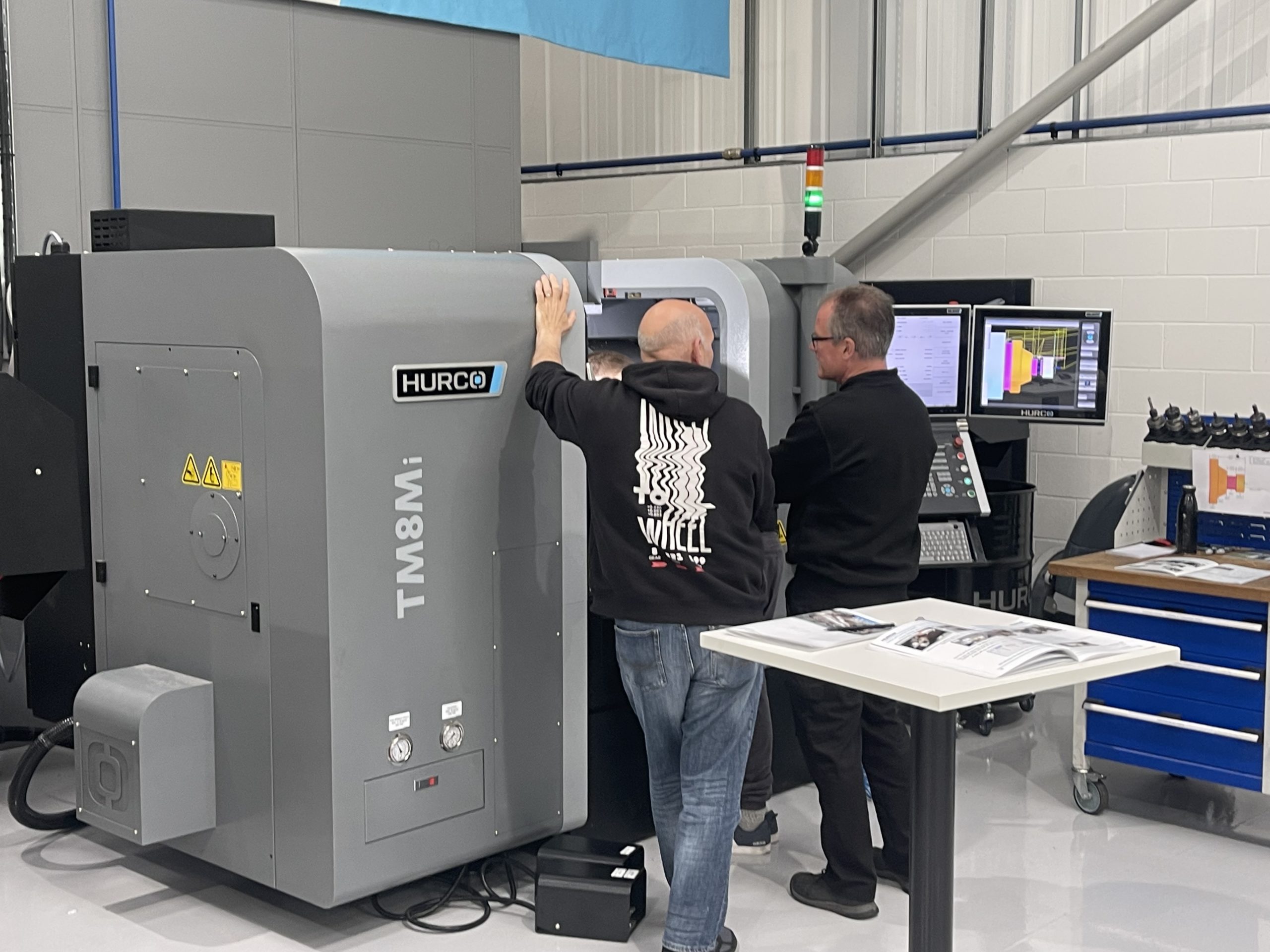
Machinery & Manufacturing chats with Hurco Europe MD David Waghorn about technology, trends and how a business founded in the late 70s evolved into one of the UK’s most recognisable CNC machine tool suppliers.
David Waghorn has been at Hurco for a staggering 36 years. He mentions it during our conversation almost as a throwaway comment, but it actually explains quite a lot. After all, longevity and continuity feel deeply embedded within Hurco’s identity. This is a company that launched its first European subsidiary in High Wycombe back in 1979, survived everything from the early-1990s recession to Brexit and Covid, and somehow emerged with a customer base loyal enough that a significant number now run fleets of more than 20 Hurco machines.
“Even through all the economic shocks this country has endured, we’ve managed to keep finding customers and keep growing the business,” states David. “In 2019, we doubled our footprint by moving into a 45,000 ft² facility.”
Today, Hurco Europe employs 60 people, turns over £25 million and estimates its UK market share at around 20%. Not bad for a business that originally entered a machine tool landscape dominated by world-renowned brands of the time like Bridgeport and Cincinnati.
But as our chat unfolds, it quickly becomes clear that Hurco’s UK story isn’t simply about machine tools. It’s also about technologies like automation and controls. And it’s easy to see why. Hurco invented one of the most influential control concepts the industry has ever seen: conversational programming.
The conversational revolution
Hurco’s origins stretch back to 1968 in Indianapolis, Indiana, when Gerald Roch and Edward Humston founded the company that would ultimately become a global CNC machine tool brand. Roch, an industrial engineer with a fascination for simplifying manufacturing processes, would go on to develop conversational programming and secure the patents behind it.
“It was revolutionary,” remarks David. “A machine shop could buy a Hurco mill and suddenly they didn’t need to learn complicated G-code programming. You simply answered questions on the control.”
That concept became the foundation of Hurco’s long-term strategy. While many control OEMs sought to supply multiple machine tool brands, Hurco kept everything in-house.
“When you buy a Hurco machine, you get a Hurco control. The machine, the software and the support all come from one place.”
That distinction remains important today. In an industry where disputes sometimes arise between machine OEMs and third-party control suppliers, Hurco continues to offer what David calls “single-source responsibility”. Just as importantly, many of the company’s engineers and support staff have spent decades with the business, giving customers valuable continuity. “Service is everything. If a customer calls needing help, we move quickly. Keeping spindles turning is always the priority.”
High Wycombe beginnings
Hurco initially operated through a nearby agent before establishing Hurco Europe in High Wycombe as the company’s first European subsidiary. A major step followed in 1982 when the business acquired Agemaspark, a manufacturer of die-sink EDM machines.
“At that point, EDM was a huge part of our business,” comments David. “We were also involved in CADCAM software, sheet metal fabrication and, to a lesser extent, machining centres.”
Interestingly, Hurco’s early embrace of CADCAM also gave the company a front-row seat to the growing pains of digital manufacturing.
“Early CADCAM systems were not what I would ‘robust’ technology,” recalls David. “In fact, they only really served to reinforce my confidence in conversational programming. It was so easy to create sophisticated 2.5D shapes directly on the control, rotate contours, move geometry around and get parts machined quickly without relying on hit or miss software.”
Evolution of the machine
The Hurco of today of course looks vastly different from the Hurco of the 1990s. Back then, the business competed heavily in the three-axis VMC market, often against lower-cost brands. But over the past two decades, Hurco has steadily repositioned itself much further up the value chain.
“Our evolution has been towards five-axis machining and higher-specification machines. Today, around 35% of our machine sales by volume are five-axis models. This transition mirrors broader trends within UK manufacturing. The traditional three-axis VMC market has shrunk massively. Even small subcontractors now want extensive machine capabilities and automation.”
Hurco’s focus on high-mix, low-volume machining appears particularly well suited to modern UK manufacturing realities, where flexibility increasingly matters more than outright production volume.
“The more complex and varied the parts, the more attractive a Hurco machine becomes,” asserts David. “If you don’t know what job is coming through the door tomorrow, versatility becomes everything.”
That versatility still centres heavily around Hurco’s WinMax CNC control, whose twin-screen interface remains one of the company’s, and the industry’s, defining features.
“Program on one screen and see the toolpath and graphics on the other. Everyone recognises it.”
Importantly, Hurco argues that conversational programming still has relevance even in a world dominated by sophisticated CADCAM systems.
“A good machinist will mix and match,” notes David. “Maybe they’ll use CAM for complex surfacing but conversational for fixtures, one-offs or quick edits at the machine. That flexibility is a huge advantage.”
Automation without complexity
Alongside five-axis machining, automation has become another major pillar of Hurco’s strategy.
Again, though, the emphasis is less on mass production and more on flexible automation for smaller batch sizes.
The company’s Procobot systems handle component loading for batches typically ranging from 30 to 300 parts. Hurco also offers Erowa systems with fixed pallet sizes for more advanced automation applications. More recently, Hurco introduced the PC25 automation system, unveiled publicly for the first time at the recent MACH 2026 exhibition. Positioned between Procobot and Erowa, the PC25 utilises a Kawasaki industrial robot to load either vices or pallets directly into a Hurco five-axis machining centre.
“The clever part is that it uses the same Hurco Automation Job Manager software as Procobot,” he reveals. “That simplicity reflects our wider philosophy: sophisticated capability without unnecessary complication. Training can take as little as a day.”
Resilience through change
As our meeting draws to a close, the conversation returns full circle to business resilience, something that hasn’t happened by accident at Hurco. The company restructured heavily during the early 2000s, moved towards a wholly owned manufacturing operation in Taiwan, broadened its product portfolio and steadily targeted higher-value applications.
“We rebuilt the business to endure,” remarks David. “Thankfully, that proved to be the right decision given everything the industry has faced since.”
Despite the challenges, Hurco continues to push forward, targeting 40% new customers every year and evolving its machine range, which now spans more than 50 models.
“We still see growth opportunities over the next five years,” he concludes. “There’s definitely potential for us to become a £30 million-plus business.”
Want to know more about this article?
Ask us below...